简体中文
简体中文 English
- PRODUCTSIndustrial PoE Media Converter Industrial Media Converter Industrial Unmanaged PoE Switch Industrial Managed PoE Switch Industrial Unmanaged Ethernet Switch Industrial Managed Ethernet Switch Industrial PoE Injector Industrial PoE Splitter Industrial PoE Extender DIN-Rail Power Supply Rackmount DIN-Rail BracketHDMI Over Fiber ConverterSDI Over Fiber ConverterSDI Over Fiber Converter 12G-SDI Over Fiber Converter 3G-SDI Over Fiber Converter HD-SDI Over Fiber ConverterDVI Over Fiber ConverterAHD/CVI/TVI Over Fiber
- SOLUTIONS
- Download
- ABOUT
- CONTACT


Introduction
As IP surveillance systems continue to evolve toward higher resolutions, AI analytics, and remote monitoring capabilities, network infrastructure has become more important than ever. A reliable Industrial PoE Switch provides both power and data transmission through a single Ethernet cable, simplifying deployment while improving system stability.
Whether you are building a security network for manufacturing plants, transportation hubs, utility facilities, warehouses, or outdoor monitoring locations, choosing the right Industrial PoE Ethernet Switch can significantly improve performance and reduce maintenance costs.
This guide explains how to deploy Industrial PoE Switches for IP camera systems in 2026 and highlights key factors to consider when designing a surveillance network.
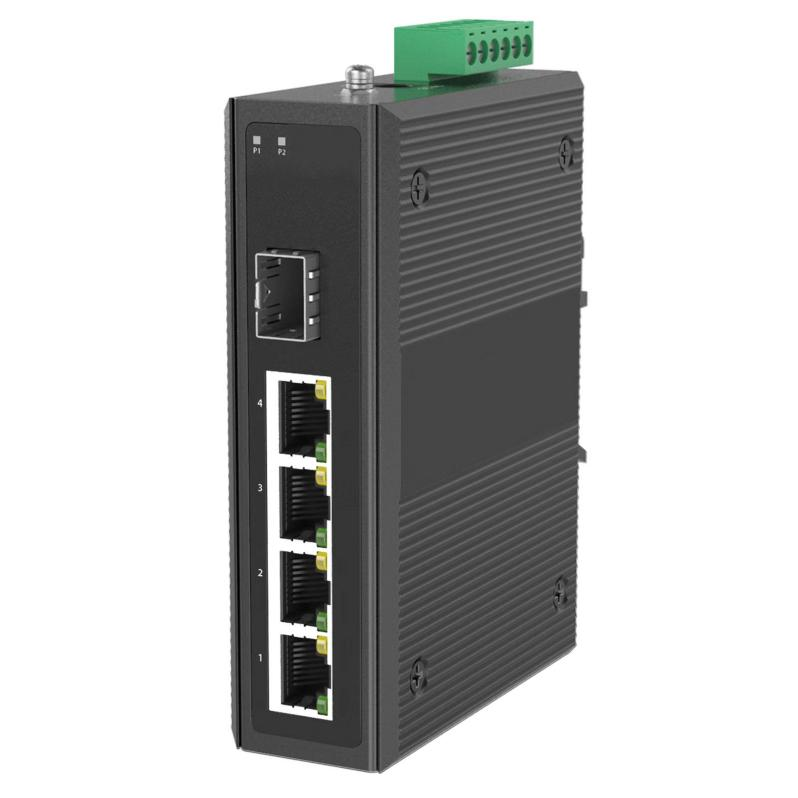
Why Use an Industrial PoE Switch for IP Cameras?
Unlike standard commercial switches, Industrial PoE Switches are designed to operate in harsh environments.
Typical features include:
Wide operating temperature (-40°C to 75°C)
Industrial-grade surge protection
Dual redundant power inputs
IP40 metal housing
DIN-Rail or wall mounting
Long-term reliability and stability
These characteristics make Industrial PoE Switches ideal for outdoor surveillance and mission-critical monitoring applications.
Benefits of PoE for Surveillance Systems
Simplified Installation
PoE technology eliminates the need for separate power wiring.
Each IP camera receives:
Data connectivity
Electrical power
Through a single Ethernet cable.
Benefits include:
Faster deployment
Lower installation costs
Easier maintenance
Reduced cable clutter
Flexible Camera Placement
Without requiring nearby AC outlets, cameras can be installed in:
Parking lots
Railway stations
Factory perimeters
Warehouses
Utility substations
Highway monitoring points
This flexibility is particularly valuable for large industrial sites.
Centralized Power Management
Industrial Managed PoE Switches allow administrators to:
Monitor power consumption
Reboot cameras remotely
Schedule power cycles
Identify device failures quickly
This reduces downtime and maintenance visits.
Choosing the Right PoE Standard
Different IP cameras require different power levels.
| PoE Standard | Maximum Power |
|---|---|
| IEEE 802.3af | 15.4W |
| IEEE 802.3at (PoE+) | 30W |
| IEEE 802.3bt | 60W-90W |
Recommended Applications
802.3af
Standard HD cameras
Fixed surveillance cameras
802.3at PoE+
PTZ cameras
IR night vision cameras
AI-enabled cameras
802.3bt
Multi-sensor cameras
High-power edge devices
Advanced security equipment
Always verify camera power requirements before selecting a PoE Switch.
Calculating PoE Power Budget
One of the most common deployment mistakes is underestimating PoE power requirements.
Example:
8 IP Cameras × 15W = 120W
Recommended safety margin:
120W × 1.3 = 156W
Therefore:
An 8 Port Industrial PoE Switch with 180W or 240W PoE Budget would be recommended.
Adequate power reserves help ensure long-term network stability.
Recommended Network Architecture
Small Deployment
4–8 IP Cameras
1 Industrial PoE Switch
1 NVR
Suitable for:
Small factories
Warehouses
Office buildings
Medium Deployment
16–24 Cameras
Multiple Industrial PoE Switches
Fiber uplinks
Centralized NVR
Suitable for:
Logistics centers
Industrial campuses
Commercial facilities
Large Deployment
Hundreds of Cameras
Layer 3 Industrial Switches
10G Fiber Backbone
Core Aggregation Network
Suitable for:
Smart cities
Airports
Rail transit systems
Utility infrastructure
Why Gigabit Uplinks Matter
Modern surveillance systems generate significant network traffic.
Examples:
4MP Cameras
8MP Cameras
AI Video Analytics
Continuous Recording
Gigabit uplinks prevent bottlenecks and ensure smooth video transmission.
Recommended configurations:
Gigabit PoE Ports
Gigabit SFP Fiber Uplinks
10G SFP+ Uplinks for large deployments
Advantages of Fiber Uplink Industrial PoE Switches
Fiber connectivity provides:
Longer transmission distances
Better electromagnetic interference resistance
Higher reliability
Common industrial environments include:
Manufacturing facilities
Utility substations
Transportation networks
Outdoor surveillance systems
Industrial PoE Switches with SFP ports are often preferred in these scenarios.
Key Features to Look For
When selecting an Industrial PoE Switch for IP camera deployments, prioritize:
Network Features
VLAN
QoS
IGMP Snooping
Port Mirroring
Link Aggregation
STP/RSTP
Industrial Features
Wide Temperature Design
Surge Protection
Redundant Power Inputs
Fanless Design
Industrial Metal Housing
Management Features
Web Management
SNMP
CLI
Remote Monitoring
PoE Scheduling
These capabilities improve both performance and maintainability.
Common Deployment Mistakes
Insufficient PoE Budget
The most frequent issue.
Always calculate total device power consumption before purchasing.
Ignoring Future Expansion
Choose a switch with spare ports and additional power capacity.
Future camera additions are common.
Using Commercial Switches Outdoors
Commercial switches often fail in:
Extreme temperatures
Dusty environments
High-vibration locations
Industrial-grade equipment provides significantly better reliability.
No Fiber Backbone
Long-distance copper connections can create performance and interference issues.
Fiber uplinks are strongly recommended for larger surveillance networks.
Conclusion
An Industrial PoE Switch is the foundation of a reliable IP camera network. By combining power delivery, data transmission, industrial durability, and centralized management, these switches simplify deployment while ensuring long-term performance.
Whether deploying surveillance systems in factories, transportation facilities, utility sites, or outdoor environments, selecting the correct Gigabit Industrial PoE Switch, calculating an appropriate PoE budget, and planning for future expansion will help build a stable and scalable security infrastructure.