简体中文
简体中文 English
- PRODUCTSIndustrial PoE Media Converter Industrial Media Converter Industrial Unmanaged PoE Switch Industrial Managed PoE Switch Industrial Unmanaged Ethernet Switch Industrial Managed Ethernet Switch Industrial PoE Injector Industrial PoE Splitter Industrial PoE Extender DIN-Rail Power Supply Rackmount DIN-Rail BracketHDMI Over Fiber ConverterSDI Over Fiber ConverterSDI Over Fiber Converter 12G-SDI Over Fiber Converter 3G-SDI Over Fiber Converter HD-SDI Over Fiber ConverterDVI Over Fiber ConverterAHD/CVI/TVI Over Fiber
- SOLUTIONS
- Download
- ABOUT
- CONTACT


Machine vision has become an important technology in modern manufacturing. Industrial cameras can inspect products, identify defects, measure dimensions, verify assembly, and monitor production processes automatically.
As machine vision systems become more advanced, reliable network communication is increasingly important. High-resolution cameras can generate large amounts of image data, while multiple cameras may need to communicate with industrial PCs, PLCs, robots, and factory control systems simultaneously.
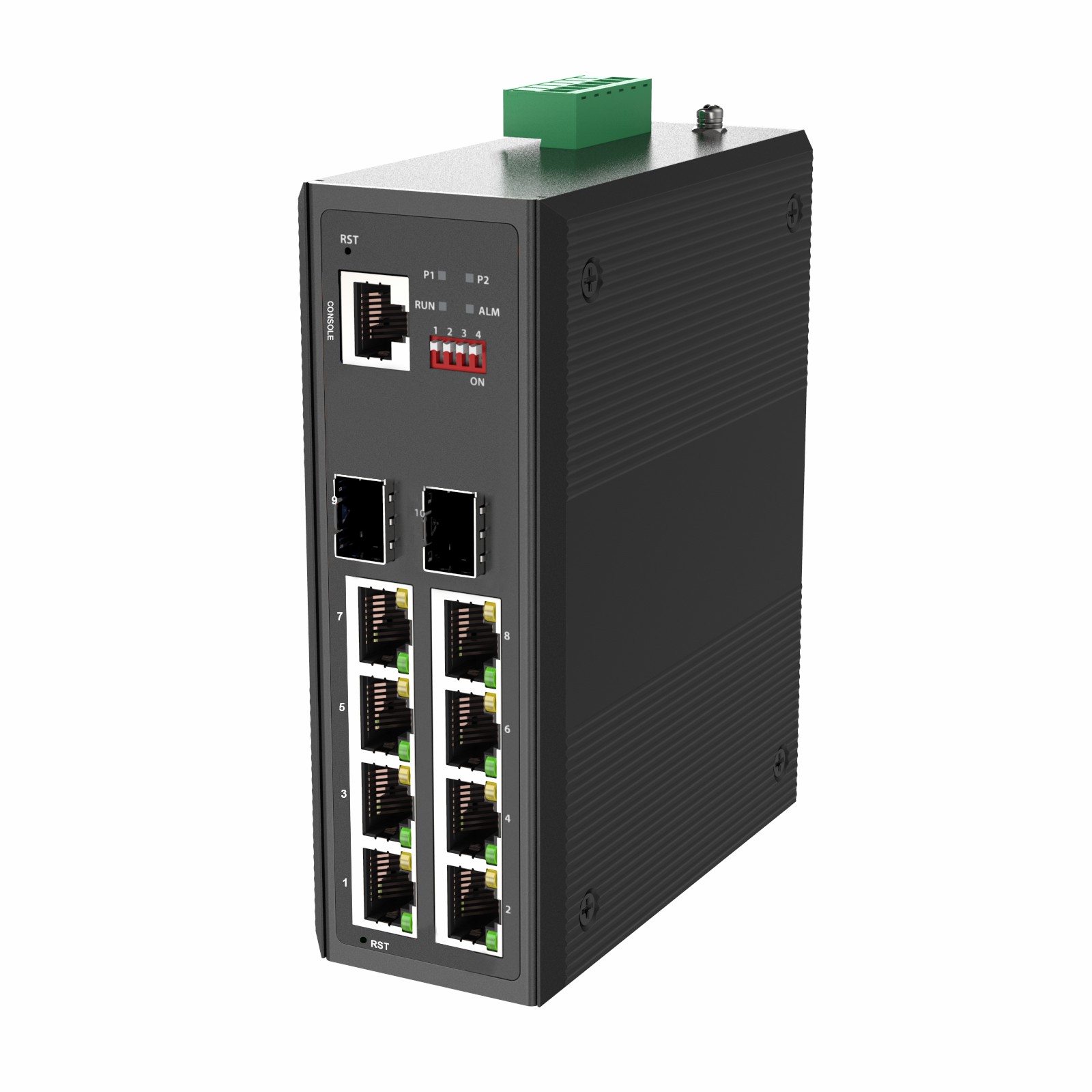
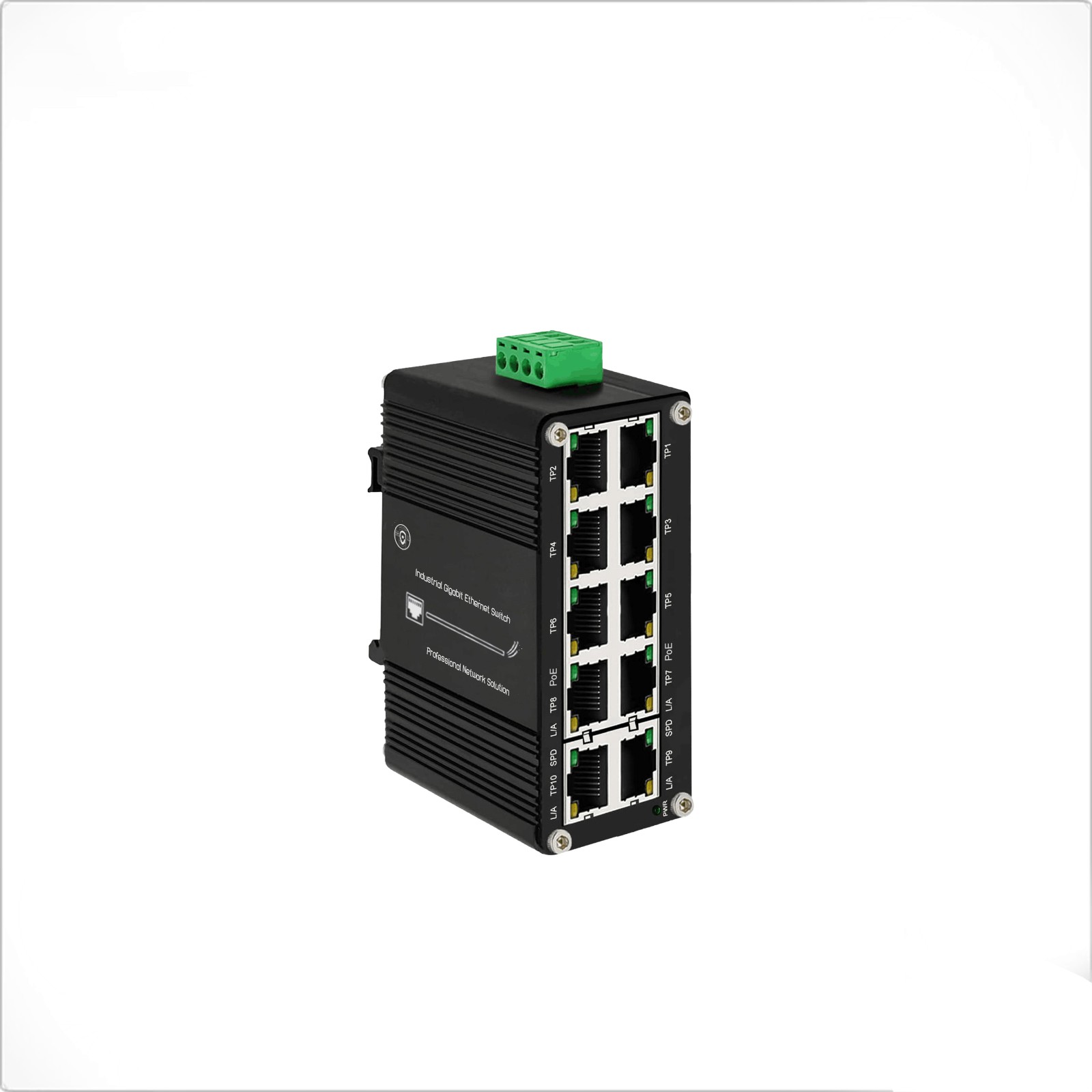
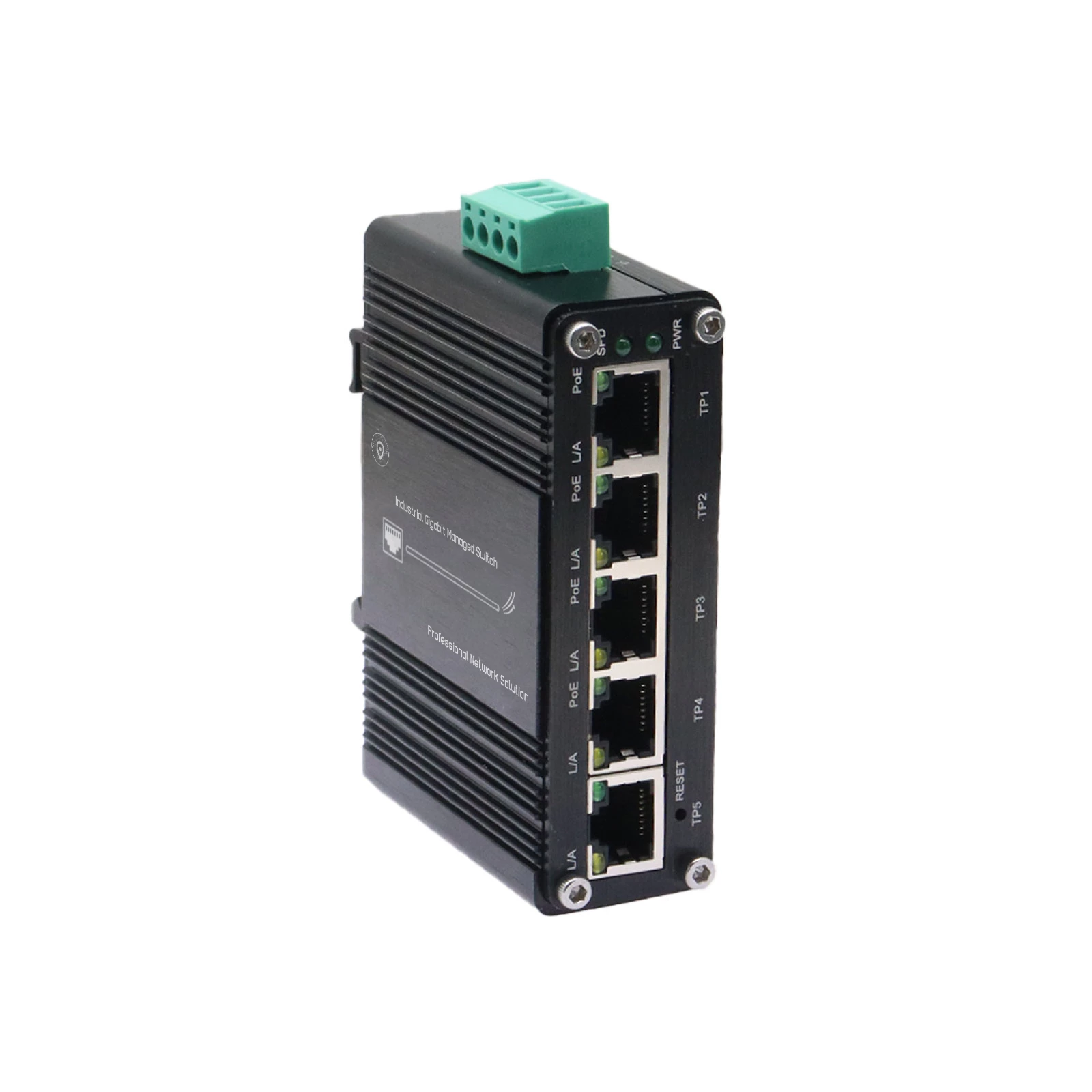
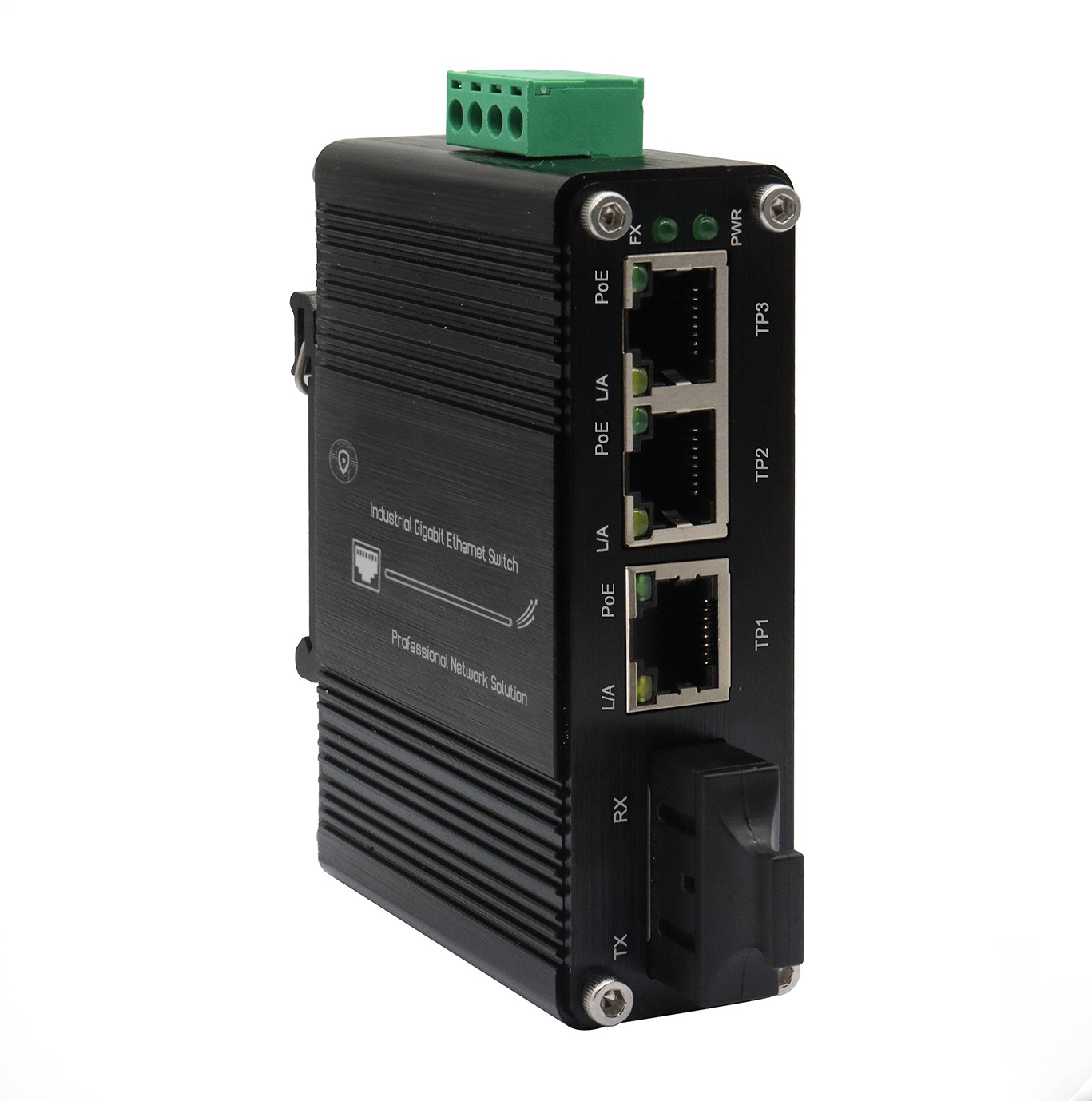
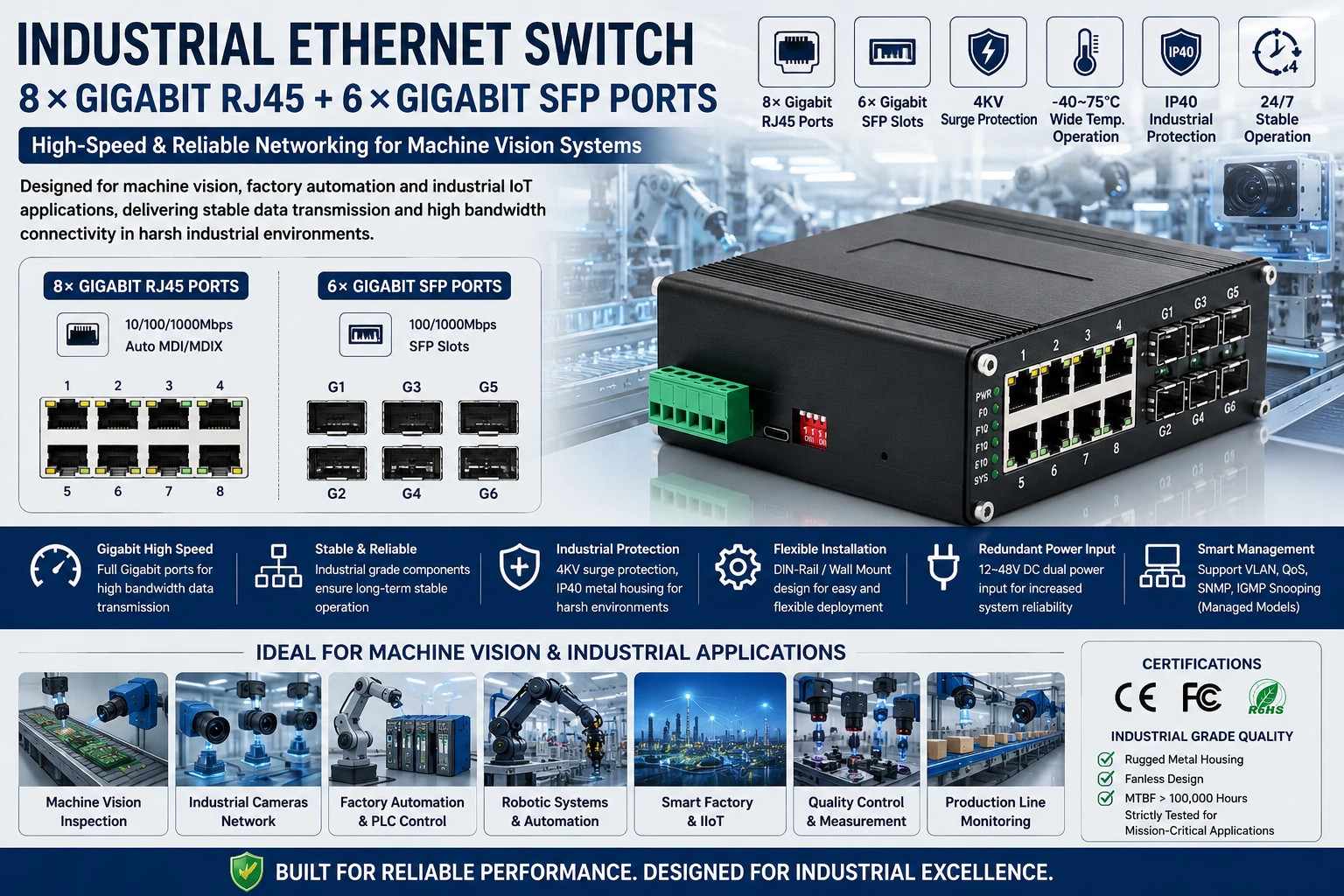
An Industrial Ethernet Switch provides the network infrastructure needed to connect industrial cameras and other automation equipment. With Gigabit Ethernet ports, fiber optic uplinks, network management functions, and industrial-grade construction, industrial Ethernet switches can support reliable machine vision networking in demanding production environments.
What Is a Machine Vision Network?
A machine vision network connects cameras and image-processing equipment with the automation systems responsible for analyzing and responding to inspection results.
A typical machine vision system may include:
Industrial cameras
Industrial PCs
Vision controllers
PLCs
HMIs
Robots
Sensors
Lighting controllers
Production equipment
SCADA systems
Industrial Ethernet switches
The network allows image data, inspection results, control commands, and production information to move between these devices.
Why Network Performance Matters for Machine Vision
Machine vision applications can place significant demands on an industrial network.
A high-resolution industrial camera can generate substantial data, particularly when images are captured at high frame rates. When several cameras operate simultaneously, network bandwidth becomes an important consideration.
A properly designed Ethernet network can help provide:
Stable camera communication
High-speed image transmission
Reliable communication between cameras and industrial PCs
Integration with PLC control systems
Flexible network expansion
Long-distance fiber connectivity
For this reason, selecting the appropriate industrial Ethernet switch is an important part of machine vision system design.
Gigabit Ethernet for Industrial Cameras
Gigabit Ethernet provides significantly more bandwidth than traditional Fast Ethernet and is widely used for industrial networking applications that require higher data throughput.
An industrial Ethernet switch with Gigabit RJ45 ports can connect:
Industrial cameras
Vision computers
PLCs
HMIs
Industrial PCs
Network gateways
When multiple cameras are connected to the same switch, engineers should consider the combined traffic generated by all devices rather than looking only at the bandwidth of an individual camera.
Fiber Optic Connectivity for Machine Vision Networks
Large factories may have production lines distributed across different workshops or buildings.
Fiber optic Ethernet can provide a practical solution for connecting remote machine vision systems to a central industrial network.
Industrial Ethernet switches with SFP interfaces can support fiber connections for:
Long-distance transmission
Production line backbone connections
Building-to-building networking
Control room connectivity
Electromagnetically noisy environments
Fiber connectivity can also provide electrical isolation between different areas of an industrial facility.
Industrial Ethernet Switches for Multi-Camera Systems
Modern production lines may use multiple cameras for different inspection tasks.
For example, a production line could use cameras for:
Product appearance inspection
Dimension measurement
Barcode or code verification
Assembly inspection
Defect detection
Position recognition
An industrial Ethernet switch can provide a centralized connection point for these cameras and the industrial computers processing their images.
When designing a multi-camera network, engineers should consider:
Number of cameras
Camera resolution
Frame rate
Network bandwidth
Number of Ethernet ports
Uplink bandwidth
Transmission distance
Network topology
Managed Industrial Ethernet Switch for Machine Vision
Managed industrial Ethernet switches can provide additional control over machine vision networks.
Depending on the model, common functions may include:
VLAN
VLAN can separate machine vision traffic from other factory network traffic.
For example, camera and vision-processing traffic can be placed in a dedicated network segment while maintaining connectivity with the PLC or SCADA network.
QoS
Quality of Service can help prioritize important traffic when multiple applications share the same network.
IGMP Snooping
Some industrial vision and automation applications use multicast communication. IGMP Snooping can help manage multicast traffic and prevent unnecessary transmission to network devices that do not require it.
SNMP
SNMP can provide centralized monitoring of managed network equipment and help network administrators identify connectivity issues.
Network Redundancy
For production environments where network availability is important, redundancy technologies can provide alternative communication paths in the event of a link failure.
Connecting Machine Vision With PLC Systems
Machine vision is often part of a larger automated production process.
A typical communication flow may look like:
Industrial Camera → Ethernet Switch → Vision PC → PLC → Robot / Production Equipment
The camera captures an image, the vision system analyzes the image, and the PLC uses the inspection result to control the next production step.
For example, a vision system may identify whether a product meets a predefined quality requirement. The PLC can then control a robotic arm or actuator based on the inspection result.
The industrial Ethernet switch provides the communication infrastructure connecting these systems.
Machine Vision and Smart Factory Networks
Machine vision is also an important component of smart manufacturing.
Vision inspection data can be integrated with:
Production monitoring
Quality management
MES systems
SCADA platforms
Industrial IoT gateways
Manufacturing analytics
Predictive maintenance systems
This allows manufacturers to move beyond simple image inspection and use production data for broader manufacturing analysis.
An industrial Ethernet switch can serve as a communication point between the machine vision system and the wider factory network.
Industrial Ethernet Switch Features for Machine Vision
When selecting a switch for an industrial vision application, consider the following features.
High-Speed Ethernet Ports
Gigabit Ethernet ports provide higher bandwidth for camera and industrial PC connections.
SFP Fiber Interfaces
Fiber uplinks can support long-distance connections between production areas and network backbones.
Sufficient Port Capacity
The switch should provide enough ports for current cameras and allow additional devices to be added in the future.
Network Management
Managed features such as VLAN, QoS, SNMP, and IGMP Snooping can provide additional network control.
Industrial-Grade Design
Machine vision equipment may be installed directly on production lines, where temperature, electrical interference, and continuous operation can create challenging conditions.
Industrial Ethernet switches designed for industrial environments can provide more suitable deployment options.
Applications of Industrial Ethernet Switches for Machine Vision
Automated Quality Inspection
Industrial cameras can inspect product surfaces, dimensions, components, and assembly conditions.
Electronics Manufacturing
Machine vision can be used for component inspection, positioning, assembly verification, and defect detection.
Automotive Manufacturing
Vision systems can support automated inspection of components, assemblies, and finished products.
Packaging Inspection
Cameras can verify product labels, packaging conditions, codes, and positioning.
Pharmaceutical Manufacturing
Vision systems can support packaging and product inspection processes.
Warehouse Automation
Industrial cameras can work with robots, scanners, and automated equipment for identification and positioning.
How to Choose an Industrial Ethernet Switch for Machine Vision
Before selecting a switch, evaluate the complete network architecture.
1. Calculate Camera Bandwidth
Consider camera resolution, frame rate, image format, and the number of cameras operating simultaneously.
2. Select Appropriate Port Speed
Gigabit Ethernet is suitable for many industrial camera networks, while higher-speed uplinks may be useful for aggregating multiple cameras.
3. Consider Fiber Uplinks
For long-distance connections or factory backbones, SFP fiber interfaces can provide flexible connectivity.
4. Determine Port Requirements
Calculate current ports and reserve additional capacity for future expansion.
5. Choose Managed or Unmanaged
Unmanaged switches can be suitable for simple camera networks. Managed switches provide additional functions for larger and more complex systems.
6. Consider the Industrial Environment
Check temperature range, power requirements, housing design, installation method, and electromagnetic conditions before deployment.
Building a Reliable Machine Vision Network
A machine vision system is only as reliable as the communication infrastructure supporting it.
A well-designed industrial Ethernet network should provide sufficient bandwidth while maintaining stable communication between cameras, vision computers, PLCs, robots, and factory management systems.
For larger installations, a hierarchical network architecture can be used:
Machine Vision Devices → Industrial Ethernet Switch → Fiber Uplink → Factory Network → SCADA / MES
This approach allows individual production lines to operate as local networks while maintaining connectivity with centralized factory systems.
Conclusion
Industrial PoE Switch | Managed PoE Switch | Gigabit PoE Switch | DIN Rail PoE Switch | Industrial Ethernet Switch | Smart Transportation Network | Traffic Monitoring System | Outdoor PoE Switch | PoE for CCTV | Fiber Uplink PoE Switch